
America spends over $5 trillion a year on healthcare, and a full trillion of that goes to administrative work. Magicare is attacking that waste in skilled nursing facilities (SNFs), where this work hurts the most. Admissions teams race to review 400+ pages of contradictory PDFs across a dozen legacy portals. It’s a massive task, but these teams are also under the clock, working against competing facilities, and helping patients waiting in hospital beds. Magicare's mission is summed up in three words: patients, not paperwork.
Their AI operating system for post-acute care turns a 60-minute admissions decision into one that takes under 60 seconds, and the entire pipeline starts with Browserbase.
TL;DR
- 60 minutes → under 60 seconds to make an admissions decision
- 200,000+ referrals retrieved, 2 million+ documents processed, and 500,000+ messages sent, all through Browserbase browser sessions
- Thousands of concurrent browser sessions running 24/7, covering every major referral portal, including a full Epic referral integration.
The problem: the data lives behind portals that predate APIs
When a hospital discharges a patient to post-acute care, the referral lands in one of 12-13 separate portals (CarePort, WellSky, Aidin, Curaspan, EnsoCare, Epic, and more). Admissions teams log into each one individually, download dozens of PDFs, and read as fast as they can. If a ventilator requirement or a bariatric need is missed, the patient may be rehospitalized, which is a devastating blow for the patient and their family, and a hit to the facility's reputation and insurance standing.
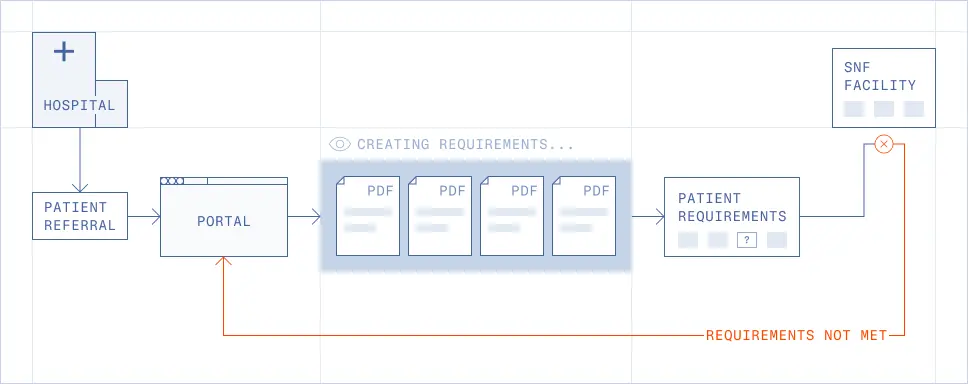
And because whoever says yes first wins the patient, speed is everything.
The catch is that most of these systems do not provide an API. There is no integration to call. The only way in is the way a human gets in, which is through a browser.
Magicare's clinical inference engine infers 500+ data points out of every referral, detects line-by-line contradictions across hundreds of pages, and writes a complete plan of care before a patient is even reviewed. This can only exist if something upstream is fetching those referrals in real time, around the clock.
"If we're not using these browsers, then the initial part of our pipeline to even process a referral in the first place doesn't exist."
— Adam Moisa, CTO, Magicare
The solution: a Browserbase-powered browser fleet as the front door
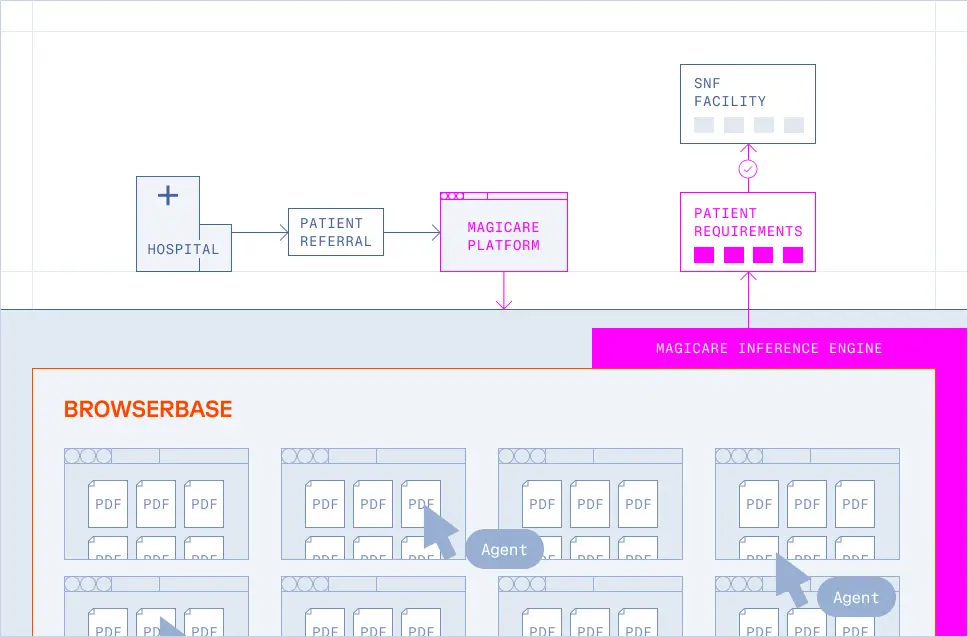
Magicare runs 13 unique agents per case on Browserbase (one per referral portal) built on raw Playwright automation. Magicare sells speed, so continuous polling across thousands of sessions demands deterministic, instant navigation, and Browserbase delivers the reliable infrastructure to run it at scale.
Those bots retrieve every new referral, download the documents, pull updates, and send messages back to hospitals, so admissions teams never even leave Magicare's platform. From there, Magicare's inference engine takes over, processing 6-7 billion tokens a day to produce a single-sentence recommendation, with every data point traceable back to the exact page and highlighted line in the source PDF.
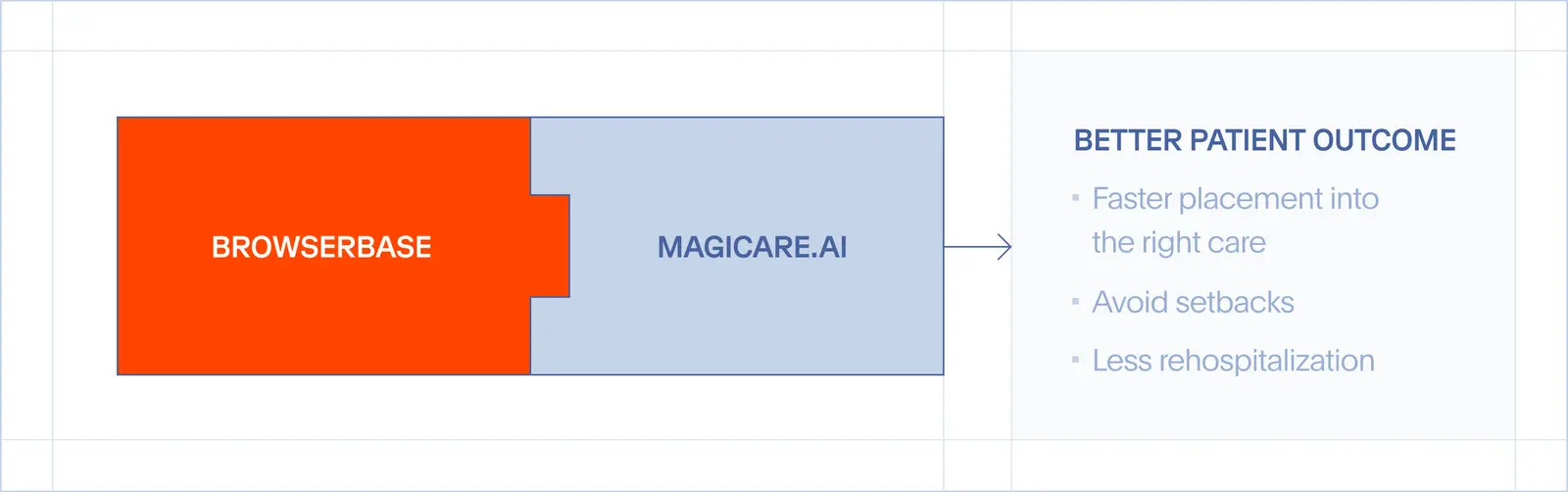
You can think of the architecture as Browserbase browser cluster → Magicare AI inference → better patient outcomes.
Long-lived sessions for legacy sites
These portals are so old that session caching doesn't work because saving and restoring a session just logs you out. So Magicare keeps Browserbase sessions alive for 12-24 hours continuously, avoiding re-authentication entirely and keeping referral retrieval truly real-time.
Taming Epic with session replay
Epic is the hardest integration in the stack. Every hospital deploys it on-prem with a slightly different configuration. Magicare supports over 60 unique Epic instances with end-to-end support. Epic's interface is nested iframes all the way down, which renders as gray boxes in standard DOM-reconstruction replays. Browserbase's enhanced session replay made Epic sessions fully visible, turning an undebuggable black box into something the team could actually see and fix.
"I don't know what I would be doing if I couldn't see my Epic replays."
— Adam Moisa, CTO, Magicare
Build vs. buy, from someone who already built it
Before Magicare, Adam built and ran his own managed browser fleet. He chose to buy anyway.
"It's always a decision, especially in the age of AI, to build it yourself or to trust the vendor. For core vendor services, you want a service provider that you can trust."
— Adam Moisa, CTO, Magicare
Browserbase had crossed the reliability threshold where rebuilding it in-house was a distraction from what makes Magicare different: the clinical inference engine. The result is a lean team running mission-critical automation for facilities across the US, without anyone managing browser infrastructure.
The results: admissions at machine speed
- Under 60 seconds from referral to recommendation, down from 60 minutes
- 200,000+ referrals and 2 million+ documents retrieved through Browserbase
- 500,000+ messages sent between facilities and hospitals without leaving Magicare's platform
- Thousands of concurrent sessions, 24/7, across 13 portals and 60 Epic instances
For SNFs, that speed compounds into a network effect. When a neighboring facility responds in under a minute, taking 60 minutes means losing the patient. And for patients, it means getting to the right care faster.
What's next
Magicare's vision goes well beyond admissions. They’re a single agentic operating system guiding the entire patient journey, from pre-admission through discharge, with staffing, compliance, prior auth, revenue cycle management, all driven by one source of clinical truth. Every one of those capabilities sits on the same foundation that browsers that can reach the systems where healthcare data actually lives. Browserbase is that foundation.
Ready to build? Join Magicare and the other companies running mission-critical automation on Browserbase. Give your agents the web.
Start building with Browserbase
Run headless browsers for your agents and automations at scale. Get started free in minutes.