

I was in a meeting recently when someone asked me:
“Can I throw a wrench into that? Look at Data.gov. Government data is already machine-readable. Agents don't need to navigate websites the way humans do. The web itself is going to change.”
I thought it was a very interesting point. We spend so much time talking about AI agents navigating websites, clicking buttons, filling out forms, and solving CAPTCHAs. But what happens when websites start supporting agents directly? It made me curious. Will we even need CAPTCHAs in a web designed for both humans and AI agents?
Data.gov is already machine-readable
The U.S. government's Data.gov is an example of how software can interact with information without navigating a website like a human.
- Software can discover datasets and access structured information programmatically.
- Agents don't necessarily need to navigate a visual website.
- APIs can use keys and rate limits instead of visual CAPTCHA challenges.
Of course, APIs and machine-readable data existed long before AI agents. Data.gov wasn't built specifically for them. But it illustrates something important: machines don't always need a browser to interact with the web.
AI can already solve many visual CAPTCHAs
CAPTCHAs were designed around the assumption that certain tasks are easy for humans but difficult for machines.
Think about identifying traffic lights, bicycles, or distorted letters.
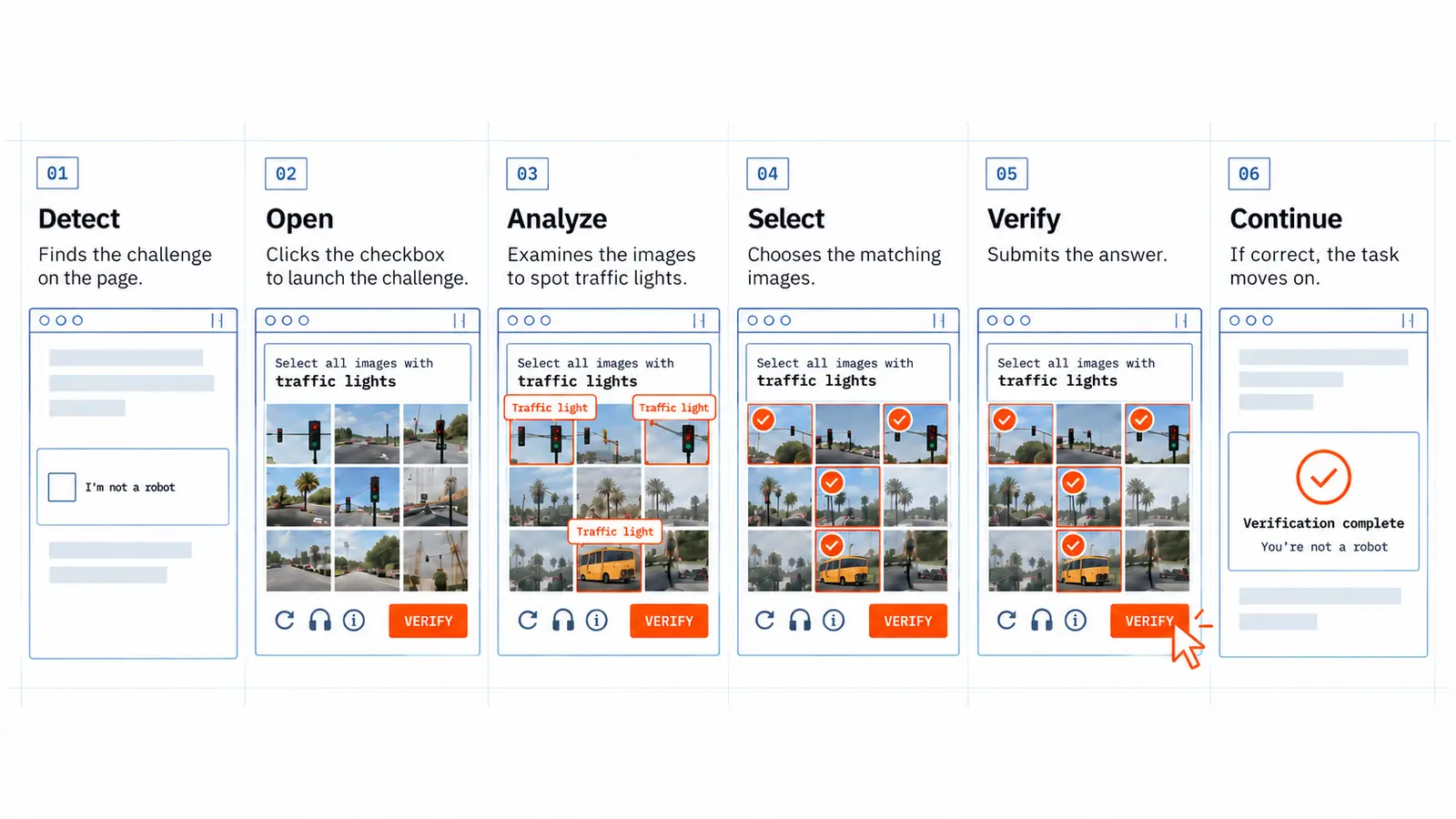
Today, AI systems can approach these challenges using:
- OCR to recognize distorted text.
- Computer vision to identify objects.
- Vision-language models to interpret instructions and reason about images.
A computer-using agent (CUA) can combine visual understanding with mouse and keyboard interactions to attempt an image CAPTCHA. The research has moved quickly.
2025 — Halligan
At USENIX Security 2025, researchers introduced Halligan, an agentic vision-language system that achieved a 60.7% success rate across 2,600 visual CAPTCHA challenges covering 26 types.
What interested me was that the system could attempt different kinds of visual puzzles without requiring a separate solver for every challenge.
Read the research: Are CAPTCHAs Still Bot-hard?
September 2026 — Robot Visions
A more recent study reported a 92.6% success rate across 500 real-world reCAPTCHA sessions using freely available, locally running models.
The interesting part is that solving these challenges didn't necessarily require expensive frontier models.
Read the research: Robot Visions — Breaking reCAPTCHA at Zero Cost and Zero Shot
September 2026 — CAPTCHAs in the Agentic Era
Another study reported 85.4% accuracy across 16 challenge classes, using an adaptive approach combining visual detection and language-model reasoning.
Read the research: CAPTCHAs in the Agentic Era
These studies evaluated different systems and challenges, so the percentages aren't directly comparable. They also don't prove that every CAPTCHA can be defeated. Still, I find it fascinating that machines can increasingly solve puzzles originally designed to keep machines out.
Bot detection is already changing
The industry has been moving beyond visual puzzles for some time.
- Cloudflare Turnstile uses background browser checks to reduce the need for visual CAPTCHA challenges.
- Google reCAPTCHA supports risk-based assessments that don't always require a visible challenge.
- Web Bot Auth lets trusted agents prove who they are, so websites can let them through and keep blocking abusive bots.
But removing a visual puzzle doesn't remove the need for security. Websites still need to protect themselves against fraud, spam, scraping, and unauthorized activity.
Meta and Amazon make this more interesting
In September 2026, reports emerged that Amazon had blocked Meta's Muse AI agent from shopping on its website. This wasn't necessarily a CAPTCHA problem. It was an access and authorization problem.
A customer might want an AI agent to shop on their behalf. The agent might be technically capable of navigating the website. But the website owner may not permit that interaction.
It raises some interesting questions:
- Who operates the agent?
- Which human or organization does it represent?
- Has the human authorized the action?
- Does the website permit that agent?
Even if we solve agent identification, we haven't necessarily solved agent access.
Will humans and agents have separate identities?
Someone asked me another question recently: “Will we eventually know whether a visitor is human or an AI agent? Will they have separate identities?” I think this is likely, and we're already seeing the technical foundations. Imagine I ask an AI agent to book a flight.
The airline may need to verify three different things:
- Human identity: Who is the customer?
- Agent identity: Which software is making the request?
- Authorization: Has the customer permitted the agent to make the booking?
These are separate questions. An agent might prove its identity through a cryptographic signature. But that doesn't automatically prove that I authorized it to spend $1,000. Protocols such as Web Bot Auth help establish agent identity. OAuth-based delegation and emerging agent identity approaches address permissions. Websites may still require additional verification or explicit human approval for sensitive transactions.
So, will CAPTCHAs disappear?
I don't think the answer is a simple yes or no.
Traditional visual CAPTCHAs may become less relevant as two things happen:
- AI becomes increasingly capable of solving the puzzles.
- More websites provide ways for legitimate agents to identify themselves and interact directly with services.
But websites will still need to distinguish legitimate activity from abuse. An identified agent isn't necessarily a trustworthy agent. And an authorized agent isn't automatically welcome on every website.
What does this mean for Browserbase?
There are two interesting possibilities which also defines the Browserbase opportunity
Browserbase could become a trusted access layer for agents.
If websites introduce agent-specific authentication, agents will need a way to establish their identity and access permissions. Browserbase could become the holder of those keys, managing trusted access between agents and websites that support agentic authentication. This would depend on websites accepting that model of access.
A large part of the web may never implement agentic access.
There will always be websites built primarily for humans, including legacy systems, complex interfaces, and services that don't provide agent-friendly APIs.
Browserbase already makes these websites accessible to agents today. That need doesn't necessarily disappear because other parts of the web become more agent-friendly.
The two possibilities could coexist. Browserbase could support authenticated agent access (turn on verified in the browser settings) where websites offer it, while continuing to provide browser infrastructure for websites that don't.
It's an interesting question for the broader industry as well. Will agent identity and access become part of existing infrastructure platforms, or will new companies emerge to provide these capabilities?
References
- Data.gov
- Robot Visions — September 2026
- CAPTCHAs in the Agentic Era — September 2026
- Cloudflare Turnstile
- Google reCAPTCHA
- Cloudflare Web Bot Auth
Start building with Browserbase
Run headless browsers for your agents and automations at scale. Get started free in minutes.